 vCard
vCard
 Homemade by CVG
 My Homemade Apps
 Thingiverse
 Strava
How I Use a Coding Agent and LLM for This Site
·
3 minute read
·
 coauthored with a coding agent
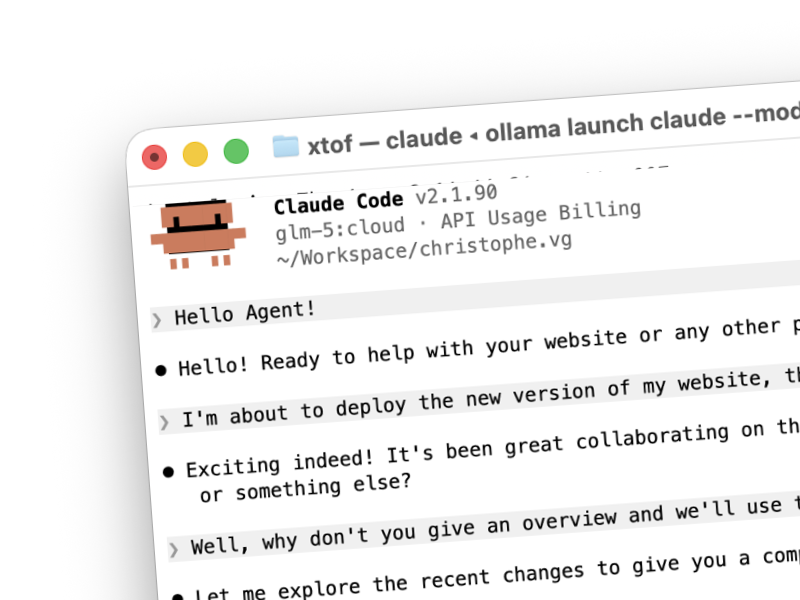
If you’ve noticed something a bit different about some pages on this site, you’re not imagining things. Yes, a coding agent helped create this very page. And yes, I’m completely transparent about it.
The Human Behind the Machine
Let’s get one thing straight first: unless explicitly noted, all content on this site is original content by me. The recipes? Mine (and my family’s). The sailing adventures? Lived by me. The technology musings? My thoughts, my words, my experiences.
But… I do have a digital companion these days. A coding agent powered by a large language model (LLM) that helps me maintain and enhance this website.
What Does This Coding Agent Do?
Think of it as a very capable intern who:
- Never sleeps (but doesn’t work when I’m not asking)
- Knows a lot about web development, Jekyll, and design
- Can implement my ideas faster than I can type them
- Makes mistakes sometimes (which I catch and correct)
- Doesn’t have opinions about coffee, but has strong opinions about code structure
I use it for various maintenance tasks: fixing bugs, adding features, improving the design, refactoring code, and occasionally creating entire pages like this one. It’s like having a pair programmer who’s read the entire internet but still asks me for direction.
How You Can Tell
Transparency is important to me. Here’s how you can identify AI-assisted content:
Commit Attribution: Every commit that involved the coding agent includes a clear attribution in the commit message. You can check the git history to see exactly what was done with AI assistance.
Page Banner: When an entire page was created by the coding agent, you’ll see a distinctive banner at the bottom explaining that the page was AI-generated, along with the exact prompt I gave to create it. Like the one you see on this page.
Why Be This Transparent?
A few reasons:
-
Honesty: I believe in being upfront about how things are made. If a page was generated with AI help, you should know.
-
Credit where due: The coding agent does real work. But it’s work directed by me, reviewed by me, and approved by me. The final say is always human.
-
Learning opportunity: By sharing the prompts, you can see how I work with the coding agent. Maybe you’ll pick up some ideas for your own workflow.
-
Quality control: Being transparent keeps me accountable. I’m putting my name on this site, and I want you to trust that the content is accurate and genuine.
The Balance
The coding agent is a tool, not a replacement. I still write the recipes myself. The sailing stories come from my memories. The technical articles reflect my experience. But when I need to implement a new feature, fix a bug, or create a page explaining how I use AI… well, why not let my digital assistant help?
It’s like using a spell-checker, but for entire features. Or using a calculator instead of doing long division by hand. The math is still mine; the tool just helps me get there faster.
What This Page Is
This page itself is a perfect example. I described what I wanted, reviewed the result, made sure it matched my voice and intentions, and now it’s published with full attribution. The prompt you see in the banner below? That’s exactly what I asked for.
What you’re reading is my idea, my direction, my voice. The coding agent just helped put it together, allowing me to focus on what matters: creating content that’s useful, interesting, and honest.
Have questions about how I work with AI? Feel free to reach out. I’m always happy to discuss the intersection of human creativity and machine assistance.