 vCard
vCard
 Homemade by CVG
 My Homemade Apps
 Thingiverse
 Strava
My Agentic Workflow
In early 2026, I took some time off to embark on an agentic journey. This journey quickly transformed into a fundamental new way of working: an agentic workflow emerged from early experiments and evolved into a complete virtual team. Given the significant impact this approach has on myself and others who read or interact with my work, I’ve created this page to provide an overview of that workflow and how I apply and manage this new AI paradigm. Whenever it’s relevant, I’ll include a link to this page, which is likely the reason you are reading this right now.
The Short Version
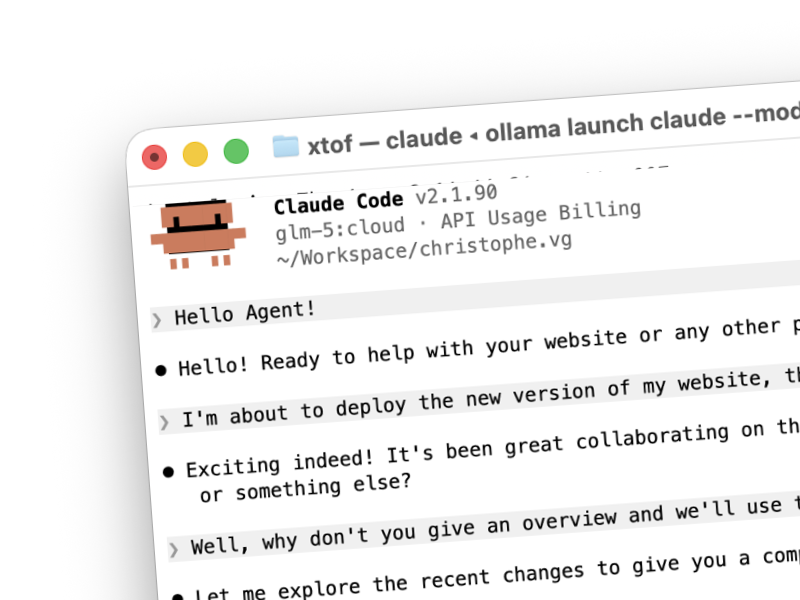
I employ agents as capable collaborators who execute my ideas more swiftly than I can type them. They possess an extensive knowledge base and can query Google faster than I can. Perhaps most importantly, they never tire. I can continuously request modifications, alternatives and one-off experiments. They keep presenting me with options to choose from.
While I grant them significant autonomy, I’ve implemented a growing set of guardrails, both technical and in person. I always review the results and, if they differ from my preferred approach, I demand clarifications and engage in discussions until we reach a consensus. The final product still bears my name and reflects my endorsement. This often means I stand corrected and have gained new knowledge. One crucial principle has been the key to this success story: letting go of many of my old, dogmatic beliefs.
Transparency
Whenever I assign agents to work, I maintain complete transparency. My agents and their skills ↗ are open-source, and every commit on GitHub is clearly attributed. Additionally, I’ve created a separate account ↗ specifically for the agents to commit and push their work. My agents and I also utilize feature branches and pull requests to enable me to validate their work with a publicly accessible trail.
Another example: On this website, unless explicitly stated, all content is original. When AI assistance is involved, it is clearly indicated, including the “prompt” used to generate it. See the page on how I use a coding agent and LLM for this site for more details.
My Approach
From the outset, I had a clear vision for creating this virtual team. I view them as highly capable interns who, while still learning my preferred behaviors, are eager to contribute. I assume the role of their mentor, assigning them tasks, reviewing their work, and providing constructive feedback on what went well and what could be improved. I then encourage them to apply these lessons learned and refine their agent definitions and the skills they utilize.
This approach guarantees that each agent and skill undergoes a genuine organic evolution, mirroring my distinct working style. I don’t rely on pre-existing agents or skills from the internet. Instead, I cultivate and train my own to my likeness.
This process demands time and involves considerable trial and error. As I write this, I’ve only just entered the third month of my journey and have now created a GitHub account for the agents ↗. At this stage, I believe that the agentic workflow has matured to the point where it can be openly shared and utilized in the same way I work with human team members. I use the same project management tools and communication methods to interact with my agents as I would with human colleagues.
In our journey of growth, we’ve traversed many of the typical phases startups encounter. Initially, we embraced the true startup style of pair programming with a single coding agent. However, as we evolved, we transitioned to a well-structured, multi-agent workflow driven by MBIs, following a multi-stage development process. Today, I define the goal, outline the business value, and conduct interviews with analysis agents until we reach a consensus on the details. Subsequently, other agents implement the solution until I approve the final result. Finally, reviewers ensure that the implementation adheres to the set guidelines and maintains our standards. Personally, I manage this process primarily through email and GitHub. Consequently, I find myself intervening at lower levels less frequently. This has truly transformed into my personal factory.
Have questions about how I work with AI? Feel free to reach out. I’m always happy to discuss the intersection of human creativity and machine assistance.